Document
Screenshots and diagrams on this page illustrate the historical desktop tools or conversion workflow; installed versions may look different.
The document properties are set in the format report window that is ported to the following settings in List & Label.
General settings
General settings such as the grid are not stored in project files in List & Label and will be ignored during conversion. These can be set in the general options of List & Label for each machine where it is installed.
Page Margins
List & Label positions objects on a page with a configured paper size. Report Builder margins are represented in part by the position and size of the converted report container. Most of the Report Builder content is ported to the report container. Therefore, the report container is placed on the page according to the margins in the source report. If the left margin is 2.55 cm, the report container with its table will be placed at 2.55 cm in the target report.
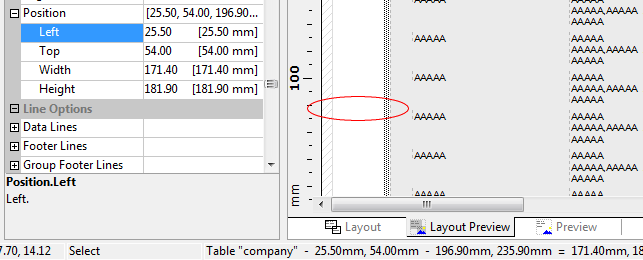
The left/top position and width/height of the report container emulate the margins from Report Builder
It is likely that not all elements will be ported inside the report container, such as the report header, the page header and the page footer. In this case, all items will be placed relative to the upper left corner of the page plus the margin settings. Assuming a margin value of 2.55 cm and a original left position of 1 cm would result in a left position at 3.55 cm for the object in the List & Label report.
Report Header and Page Header outside the report container
List & Label has a page oriented approach which results in a different way of handling layout settings compared to Report Builder. All pages are arranged in a page layout as in Word processing software. Items on the page can have dynamic sizes and there can be links between fields, however, that is a different concept than the report container which is equivalent to Report Builder's line oriented approach.
If report header and page header are ported outside, the report container has to start below the report header (page no. = 1) and below the page header (page no. > 1), which can be different. An invoice, for example, usually has a large report header and a small page header showing just the relevant heading information on consecutive pages. In order to support this and print reports properly, a spacing box is added to List & Label which will resemble the size difference between the report header and the page header. This box is invisible for the end user but important for report processing: it will be shown for the layer "first page" and hidden for the following pages. With the help of a link between this box and the report container, the details section will move up and down according to the page settings individually for the first or following pages.
An elegant feature in List & Label is the assignment of colors to layers. Items outside the report container will be shown half-transparent in the color of their respective page, for example in green the first page and in blue all following pages.
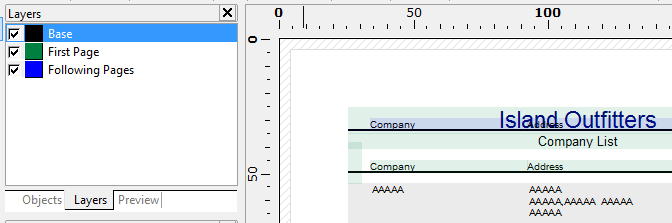
If items are ported outside the report container, they might be located at the same positions. List & Label displays color according to the layer these objects are in.
Columns
Columns are currently not supported and a warning will be logged.
Paper Source
List & Label is very powerful in terms of printer settings and sending reports to different paper trays within the same print job, however, these settings are currently not ported. Not all versions of Report Builder support this and the printer settings should be modified by hand.
Page Size
Ice Porter transforms the paper size to List & Label and takes over all settings, including custom paper sizes and the page orientation.
Layout Acceptance
Test the first page and continuation pages separately. Invisible spacing objects and links can be essential to header placement; do not delete them solely because they do not print. Compare custom paper sizes, printer hard margins, orientation, tray selection, and PDF output on the deployment environment.